

2025-04-18
Golf carts are essential for transportation on golf courses and for short distances, and their battery performance directly determines the user experience, operational efficiency, and long-term costs. When choosing a golf cart power system, 48V and 51.2V are two of the most common voltage specifications. While the voltage difference may seem small, it actually affects battery type, performance, and applicable scenarios, among other things. This article will comprehensively analyze the differences between these two specifications to help you determine which one best suits your needs.
To understand the difference between the two, it is essential to first clarify that the voltage markings of 48V and 51.2V are essentially determined by the composition of the battery cells and the battery type, which is the core source of all subsequent differences.
48V configuration is the most common configuration in standard golf carts. The vast majority of 48V golf cart batteries on the market are lead-acid batteries (including regular lead-acid and maintenance-free lead-acid), and their voltage configuration follows the nominal voltage logic of lead-acid cells—a single lead-acid cell has a nominal voltage of 12V, and a 48V battery consists of four 12V lead-acid cells connected in series (12V × 4 = 48V). Some niche 48V lithium batteries (such as ternary lithium and lithium iron phosphate) also exist, but they are not the mainstream in the market and require specific cells to be connected in series to achieve the desired voltage (e.g., ternary lithium 3.7V × 13 ≈ 48.1V, lithium iron phosphate 3.2V × 15 = 48V).
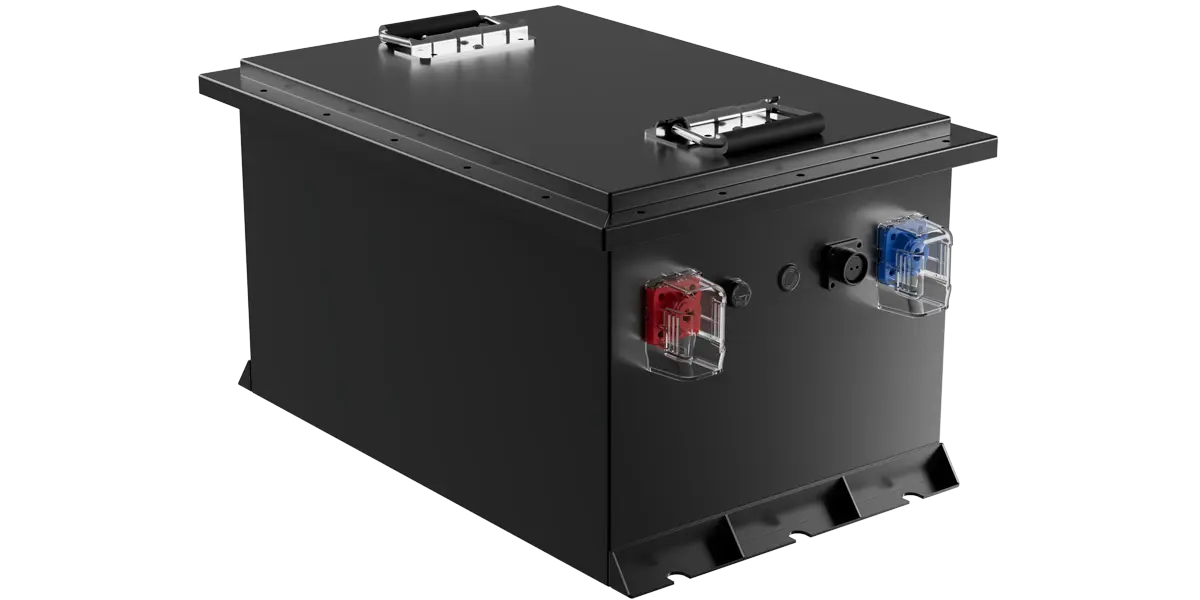
A 51.2V battery is a typical specification for lithium batteries (mainly lithium iron phosphate). Its voltage is determined by the nominal voltage of the lithium iron phosphate cell—the nominal voltage of a single lithium iron phosphate cell is 3.2V, and a 51.2V battery is exactly the result of 16 3.2V cells connected in series (3.2V × 16 = 51.2V). Due to the voltage characteristics limitations of lead-acid cells, it is impossible to achieve a voltage of 51.2V by connecting them in series. Therefore, 51.2V has become the hallmark voltage specification for lithium batteries in golf carts.
Both configurations have their advantages, and the choice between 48V and 51.2V systems largely depends on your specific performance needs, budget, and whether your golf cart is compatible with the new technology.
The voltage difference, combined with the characteristics of the battery type, directly leads to significant differences between 48V and 51.2V batteries in key performance aspects such as power output, range, and charging efficiency. This is also a core factor affecting the user experience.
According to the formula Power = Voltage * Current (P = UI), within the allowable current range of the golf cart motor and controller, the higher the voltage, the greater the output power and the stronger the performance.
48V lead-acid battery: Due to its lower voltage and higher internal resistance, lead-acid batteries experience significant voltage drop during high-current discharge, resulting in relatively smooth power output. Suitable for flat golf courses, it has weaker climbing ability (especially when fully loaded), moderate acceleration, and a maximum speed typically between 15-20 km/h.
51.2V lithium battery: With a higher voltage and lower internal resistance, lithium batteries maintain stable voltage during high-current discharge, allowing for continuous higher power output. It offers faster acceleration, stronger climbing ability (easily handling mountain courses with slopes exceeding 15°), and minimal power drop under full load, reaching a maximum speed of 20-25 km/h. It is more suitable for courses with complex terrain or operational scenarios requiring frequent starts and stops and heavy loads (such as transporting course supplies or multi-passenger golf carts).
The core factor determining driving range is the battery's total energy (Wh), not just voltage or capacity. It's important to note that while both lead-acid and lithium batteries have a capacity of Ah, differences in voltage and energy density result in significant differences in total energy for the same capacity.
For example: A 48V lead-acid battery with a capacity of 100Ah has a total energy of:
48V × 100Ah = 4800Wh; a 51.2V lithium battery of the same capacity has a total energy of: 51.2V × 100Ah = 5120Wh, a 6.7% higher total energy than the lead-acid battery. Furthermore, lithium batteries have higher charge/discharge efficiency, resulting in a greater difference in usable energy, typically extending driving range by 10%-20% compared to a 48V lead-acid battery of the same capacity.
In addition, lithium batteries have high energy density and are lightweight, reducing the overall load on the golf cart and further improving driving range; while lead-acid batteries are heavy, increasing the burden on the motor and indirectly reducing driving range.
Charging efficiency and time are primarily determined by the charging characteristics of the battery type, and are less directly related to voltage, but the charging advantages of 51.2V lithium batteries are still quite significant.
48V lead-acid batteries: Use a constant voltage and constant current charging mode. The charging process is divided into three stages: constant current, constant voltage, and float charging. The float charging stage is time-consuming (used to replenish battery capacity and prevent sulfation) and has low charging efficiency. Taking a 100Ah capacity as an example, using a matching charger, it takes 8-12 hours to fully charge, and frequent fast charging is not recommended (it will accelerate plate sulfation and shorten lifespan).
51.2V lithium batteries: Support constant current fast charging, and have high charging efficiency and low heat loss. For the same 100Ah capacity, using a 10A fast charger, it only takes 4-6 hours to fully charge; if used with a higher current fast charger (such as 20A), the charging time can be shortened to 2-3 hours. Furthermore, lithium batteries do not require a float charging stage; power can be disconnected after charging is complete, eliminating concerns about overcharging damaging the battery (equipped with a BMS battery management system that can automatically cut off charging), making them more worry-free to use.
In low-temperature environments, the activity of golf cart batteries decreases, and both voltage and capacity decline. This is a common characteristic of all batteries, but the degree of decline varies among different battery types.
48V lead-acid batteries: Low temperatures have a significant impact on lead-acid batteries. When the ambient temperature is below 0°C, the capacity drops significantly. At -10°C, the capacity may decline to 50%-60% of the nominal capacity, and charging efficiency decreases drastically, potentially even leading to charging difficulties.
51.2V lithium iron phosphate batteries: Their low-temperature performance is superior to lead-acid batteries. At -10°C, the capacity declines to 70%-80% of the nominal capacity, but basic power and range can still be maintained. However, below -20°C, the decline accelerates. However, some high-end 51.2V lithium batteries are equipped with low-temperature heating functions to further improve low-temperature adaptability, an advantage that lead-acid batteries do not possess.
To determine the economic viability of 48V and 51.2V batteries, one cannot only look at the initial purchase cost; it is necessary to consider the lifespan, maintenance costs, and replacement frequency to calculate the "Total Cost of Ownership" (TCO).
Taking a 100Ah capacity battery as an example, the market price of a complete 48V maintenance-free lead-acid battery is about $800-$1200; while the price of a complete 51.2V lithium iron phosphate battery system is about $2000-$3000. The initial cost of lithium batteries is 2-3 times that of lead-acid batteries.
Assuming the golf cart is used for an average of 2 hours per day and 300 days per year, let's compare the total cost of ownership over 5 years for both:
A 48V lead-acid battery has a cycle life of approximately 500 cycles, with about 300 charge-discharge cycles per year, therefore it needs to be replaced every 1.5-2 years. This means it needs to be replaced 3 times within 5 years. The total purchase cost is between $2400 and $3600 (US$800-$1200). Maintenance costs (such as adding water and cleaning the terminals) are about US$200 per year, totaling US$1000 over 5 years. The total cost of ownership is approximately US$2400-$3600 + US$1000 = US$3400-$4600.
A 51.2V lithium battery has a cycle life of at least 2000 cycles, with about 1500 charge-discharge cycles within 5 years, requiring no replacement. The total purchase cost is between US$2000 and US$3000. Maintenance costs are almost zero (only periodic wiring checks are needed). The total cost of ownership is approximately US$2000-$3000.
The difference between 48V and 51.2V batteries lies in the usage scenarios. Different users with different needs and different operating models will find different battery types suitable.
Key advantages: Low initial purchase cost (approximately 1/2 to 1/3 of that of lithium batteries of the same capacity), simple maintenance (maintenance-free lead-acid batteries do not require water addition, and the cost of replacing cells or the entire battery pack after a failure is low), and readily available accessories (chargers, controllers, etc. are easy to purchase, and there are many repair outlets).
Target Audience and Scenarios:
① Individual Users: Limited budget, used only at their own golf course or for short-distance commuting, low usage frequency (1-2 hours per day), flat terrain;
② Small Golf Courses: Small operating scale, few golf carts (5 or fewer), short daily mileage (≤50km), no complex hilly terrain;
③ Temporary Rental Scenarios: Short-term use, low battery life requirements, low-cost investment.
User experience: It is heavy (inconvenient to move and replace), has limited battery life and power, poor low-temperature performance, requires regular inspection (ordinary lead-acid batteries need to be filled with water), and needs to be replaced every 1-2 years. Long-term use requires frequent replacement costs.
Key advantages: long battery life, strong power, fast charging, long lifespan, lightweight (more flexible golf cart handling, easy to move), maintenance-free (no need to add water, no need for regular inspections), relatively better low-temperature performance, and low long-term operating costs.
Target Audience and Scenarios:
① Large Golf Courses/Resorts: Large-scale operations with numerous golf carts (10 or more), long daily mileage (≥50km), complex terrain (uphill sections, long distances), requiring rapid turnover of golf carts (fast charging can shorten idle time);
② Commercial Users: Such as golf cart rental companies and scenic area shuttle bus operators, pursuing high operational efficiency and low maintenance costs, requiring long-term stable battery operation;
③ High-End Individual Users: Pursuing a superior user experience, emphasizing range, power, and lightweight design, and willing to bear higher initial costs.
User experience: The initial purchase cost is high, and there are specific requirements for the charger and controller. If inferior products are selected, there may be safety risks due to incomplete BMS functions.
Never use an incompatible charger; this is the most important safety rule. The charging methods of 48V lead-acid battery chargers and 51.2V lithium battery chargers are completely different:
The 51.2V lithium battery pack was designed with compatibility with traditional 48V systems in mind, and can directly replace lead-acid battery packs in most cases. However, please note:
The difference between 48V and 51.2V golf cart batteries is essentially the difference between traditional lead-acid technology and modern lithium-ion battery technology. While the initial investment for a 51.2V system is higher, its comprehensive advantages in range, power, lifespan, convenience, and long-term economic benefits make it the future choice for an increasing number of people.
Before making a decision, please consider your usage frequency, budget, ownership plan, and performance requirements. Regardless of your choice, you can learn about the best 48V (51.2V) golf cart batteries from LEAD-WIN. Whether you're upgrading from lead-acid batteries or enhancing your existing lithium-ion battery system, our golf cart lithium-ion batteries offer a reliable and durable solution to help you make an informed choice.


